


Lot n° 40
Estimation :
20000 - 30000
EUR
Result with fees
Result
: 19 200EUR
- Lot 40
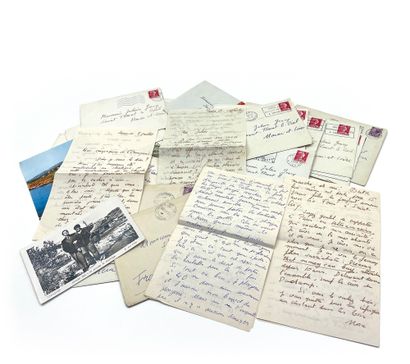
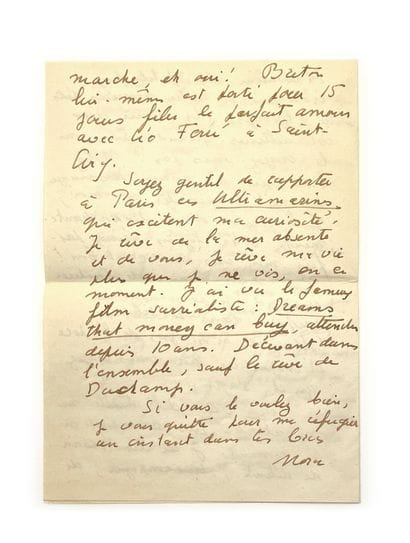
Correspondence from Nora Mitrani to Julien Gracq when the latter was staying in his house in St-Florent-le-vieil. 59 autographed letters signed "Nora", except one, and 8 autographed postcards signed, in envelopes except one letter
The first letter is dated July 9, 1955, the young woman goes on vacation in the sun of Minorca, yousoie the writer that she calls "my companion of the Orangery" and confesses to him his disorder and his "mental rumination, consecutive (sic) in me to the moments of some intensity". She proposes him a new meeting
The last one is dated September 13, 1960. Seriously ill, one of the most secret figures of surrealism confesses her fear to her "dear Julien", whom she has been on familiar terms with since their vacations in Corsica in August 1956, evokes their last trip to Spain: "the bouquet as they say, destined to close my short existence", and concludes, following a documentary on bullfighting, "I would like to end up like a torrero in the bullring, to give meaning to my death, but what awaits me is detestable"
The young woman, who probably died of cancer on the eve of her 40th birthday, is the only companion of Julien Gracq that we know of.
Former muse and mistress of Hans BELLMER, we can assume that they met around a commission from Jean-Louis BARRAULT for the first issue of the magazine Positions in 1953. The only text in which she mentions Gracq, Mitrani obtains an interview with the author on the occasion of the publication of the translation of Heinrich von KLEIST's Penthesilee by José Corti
From these bills we can say that it is from 1956 that a real couple is formed. The letters of 1955 translate a certain seduction, but a still young woman who devours the work of an author she admires, speaks of her own work and readings and confides only the weight of her absence. Those of the end of 1956 give way to the tutoiement, to a revealed feminine intimacy, to the jealousy of a man who however made "far the Messaline of my years of formerly" and where is guessed in a constant eroticism in their relation
Mainly written in summer, during what seems to be a school vacation, Julien Gracq being a teacher and taking refuge in St Florent Le Vieil to work on his work, these letters cover a small part of the spring, summer and late autumn of Nora Mitrani's last years of life
Her social life, her readings and her works are evoked: her unfinished thesis on technocracy, a conference on eroticism which is asked to her by Jacques NANTET (spelled "Nantais") for the "Cercle ouvert", "It would be, following the conference of Bataille (Erostisme and the fascination of the death, conference-debate of February 12, 1957), the female point of view by... Simone de Beauvoir, Lise (Deharme), Nathalie Sarraute and me. Tasty, isn't it?", the delivery of his text "Des esclaves, des suffragettes, du fouet" to André BRETON, a short story whose hero would be a village, the writing of a novel (perhaps Chronique d'un échouage), one guesses then that Gracq is a professor, "I'm thinking more of literary works than sociological ones. But don't yell at me, I'll go between.
It is especially in the summer, when the separation is longer, that we follow Mitrani the most assiduously: a trip to Greece, where she crosses by chance Elisa Breton accompanied by an admirer of Gracq: Odysseus Elytis who will receive the Nobel Prize for Literature in 1979, or on the occasion of the death of "our national Guitry" when a Greek comes to present his condolences to the Frenchman he knows; in St. Tropez, in Corsica, in Italy, especially in Rome, to which she says she is not sensitive; her considerations on mass tourism, her discovery followed by her passion for scuba diving, an "adventure almost too metaphysical"
In 1958, a severe car accident causing her to break her nose and ankle led her to convalesce first with the composer Germaine TAILLEFERRE, then with André and Elisa BRETON in St-Cirq-Lapopie where a week was not too much to get used to the master whom she found at first too heavy and solemn, "as if he had to prove at every moment that he was identified with surrealism. I had never noticed how little easy laughter he had" and who at the end of the stay every evening made her laugh to tears
Daily readings of Villiers de l'Isle Adam, whose ending of Axel exalted him: "Breton finds this work very Wagnerian and thinks it should suit you", and meetings, notably that of Armand Hoog, a prisoner with Julien Gracq at Ypres, a part of the novelist's life that he obviously kept [...]
217p. in-12, 1ep. in-4, 1st restaurant napkin reconverted into writing paper, and 8 postcards, including one representing Salvador Dali in Cadaquès, 63 envelopes
My orders
Sale information
Sales conditions
Return to catalogue